
TO: Interested Parties
FROM: Hart Research
DATE: April 6, 2026
RE: Voter Response to Claims of Fraud in Basic Needs Programs
Hart Research recently conducted a national survey of voters1 for the Partnership for Basic Needs to understand how Americans feel about Medicaid, SNAP, childcare, and other federal basic needs programs and to measure the impact of current fraud claims by the Trump Administration on public opinion. The survey assesses voter response to recent administration efforts to freeze funding for programs in some Democratic-led states. This memorandum highlights the key findings from this research.
1) Basic needs programs continue to be viewed favorably by large majorities of the public, and recent attacks on these programs have had virtually no impact on support for them.
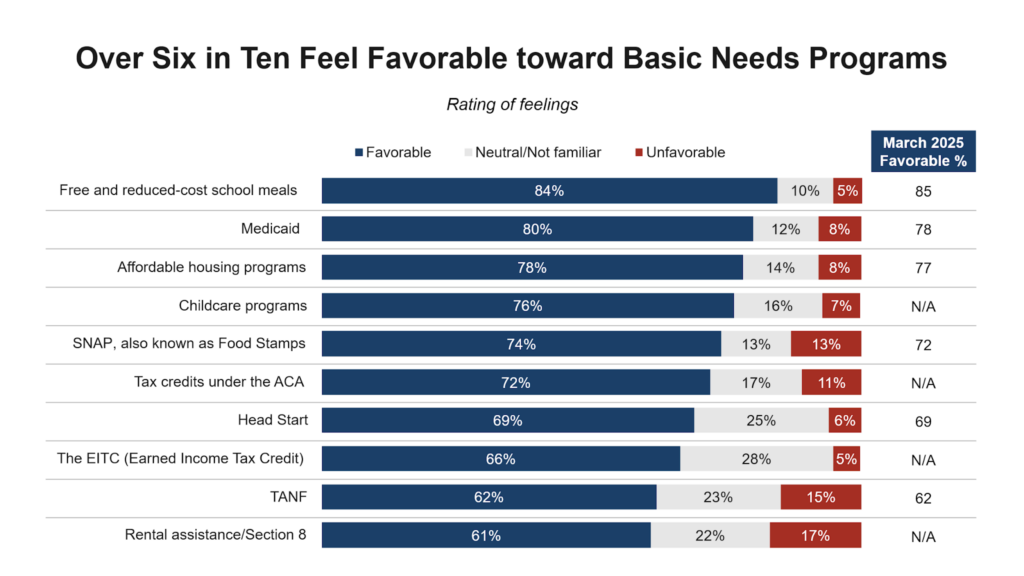
Approval for basic needs programs has remained strong over the past year, with more than six in ten voters reporting favorable views across all programs. Importantly, voters continue to view key basic needs programs positively.
- Medicaid: 78% favorable in March 2025 → 80% favorable in March 2026
- Affordable housing programs: 77% favorable in March 2025 → 78% favorable in March
- 2026
- SNAP: 72% favorable in March 2025 → 74% favorable in March 2026
2) Voters want federal funding for basic needs programs to be increased, not cut, and they reject negative characterizations of these programs.
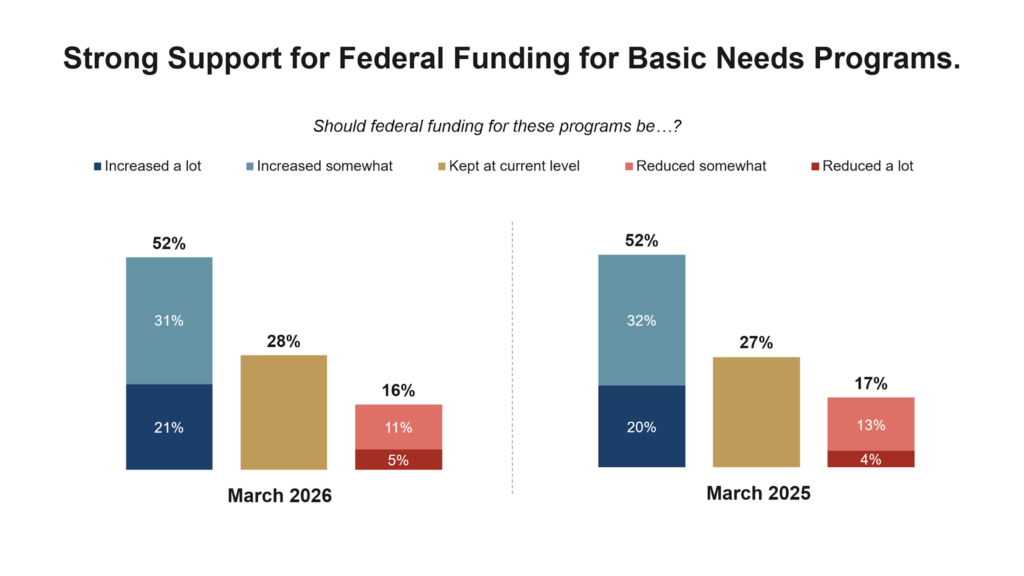
A full 52% of voters want federal funding for these programs to be increased, including one in five 21% who want it increased a lot. Only 16% want federal funding reduced. Importantly, support for increasing federal funding for basic needs programs remains just as strong as it was one year ago. Key groups within the electorate want funding for basic needs programs increased in very high numbers: 55% of independents, 53% of suburban voters, 63% of Latino voters, 62% of voters age 18-34, and 55% of non-college educated voters. Nearly a majority 48% of low-income Republicans household incomes below $50,000 want to increase federal funding.
When we ask voters which of two phrases best describes these programs, majorities reject negative characterizations by two to one. ully 64% believe they are a good investment for the country, while 31% say these programs are full of fraud and a waste of money. Similarly, 65% say these programs mainly help people who need support, compared to just 31% who say they mostly go to people who take advantage.
3) Voters are concerned by charges of fraud in basic needs programs, but they say providing assistance to those in need is a higher priority than preventing fraud.
Two-thirds of voters are concerned there is too much fraud in which scammers don’t deliver the care or services they are paid to provide 67% very fairly serious concern or where ineligible people receive benefits from a program 66% . Voters worry especially that fraud could result in less support for those who need and deserve help 73% .
At the same time, close to six in ten voters 5 % say the higher priority for these programs should be ensuring they help everyone who needs assistance, compared with just 3 % who say preventing fraud and abuse should be the top priority. Notably, a solid majority of voters in every region of the country, as well as voters of all ages, believe providing assistance to those in need should take precedence over preventing fraud and abuse. Similarly, about seven in ten voters express serious concern over the government cutting basic needs funding to accommodate other priorities:
- The federal government is slashing funding for healthcare, nutrition, and other basic needs programs, while spending billions of dollars on ICE’s deportation campaign. (69% serious concern)
- The federal government is slashing funding for healthcare, nutrition, and other basic needs programs, while cutting taxes for the rich and corporations. (72% serious concern)
4) Despite a plurality of voters finding the administration’s fraud claims credible, the Trump administration’s attempt to block federal funding for basic needs programs in some Democratic states is rejected by voters by an 11-point margin. The public believes that freezing funds will do more harm than good.
A majority of voters report they have heard about the Trump administration’s claims that there is widespread fraud in basic needs programs in Minnesota and other states led by Democrats (63%) . Nationally, almost half of voters (47%) believe the fraud claims are completely or mostly true, while 40% reject them as false. Red state voters (states with GOP governors) accept the claims (50%-36%) , while opinion is split in Blue states (45%-43%) . The charges are completely credible to Republican voters (78% to 10%) , accepted by a plurality of independents (43% to 30%) , and rejected by Democrats (17% to 72%) .
Nonetheless, just 38% of voters approve when informed that the Trump administration seeks to block federal funding for some basic needs programs in Minnesota and other Democratic-led states until they are satisfied the states have addressed claims of fraud, while a 49% plurality disapproves. Blue state voters reject this approach by 15 points (37% approve, 52% disapprove) , and even in Red states we find plurality opposition (41%- 44% ). Support for freezing basic needs funds is concentrated narrowly at the right end of the political spectrum: Republicans (70%-14%) and conservatives (72%-16%) approve of the action, but both independents (29%-52%) and moderates (27%-53%) solidly reject the freeze, and Democrats (8%-83%) and liberals (7%-87%) overwhelmingly oppose it.
- All age groups disapprove of the freeze efforts, with young voters (age 18-34) most strongly negative (26% approve, 56% disapprove).
- Black voters (20%-65%) and Latino voters (26%-60%) both strongly oppose the policy, while white voters are closely divided 44% approve, 45% approve.
- Women oppose the freeze attempt by a lopsided 23-point margin (32%-55%), while men narrowly approve (46%-41%).
5) Opponents of President Trump’s attempt to freeze funding are on strong ground when they point out the harm this will do to Americans who rely on basic needs programs, and when pointing out that cutting funding does not address any fraud problems that may exist. It is more effective to embrace the importance of accountability than to argue that claims of fraud are not true or are mere excuses to cut funding.
Voters reject President Trump’s funding freeze because they are much more concerned that funding cuts will hurt vulnerable people (4%) than that fraud and abuse are being “tolerated” in these programs (26%) . Concern about hurting the vulnerable exceeds fraud concerns among moderates (+30) , independents (+21) , and swing voters (+23).
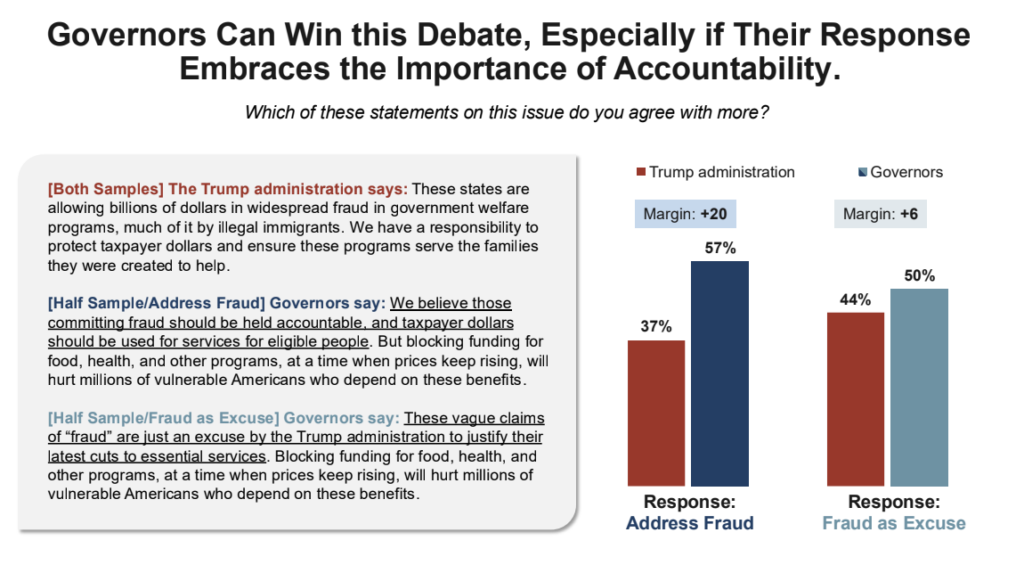
When voters are exposed to debates over the administration’s proposed funding freeze, they consistently side with governors opposed to the freeze. We find that governors win this exchange by an overwhelming margin (+20 points) when they express a commitment to holding fraudsters accountable as well as concern for those who would be hurt by program cuts. However, if a governor dismisses fraud claims as merely an “excuse” to cut programs,
much of their advantage is lost (shrinking from +20 to +6) despite voters’ concerns about harm to vulnerable people.
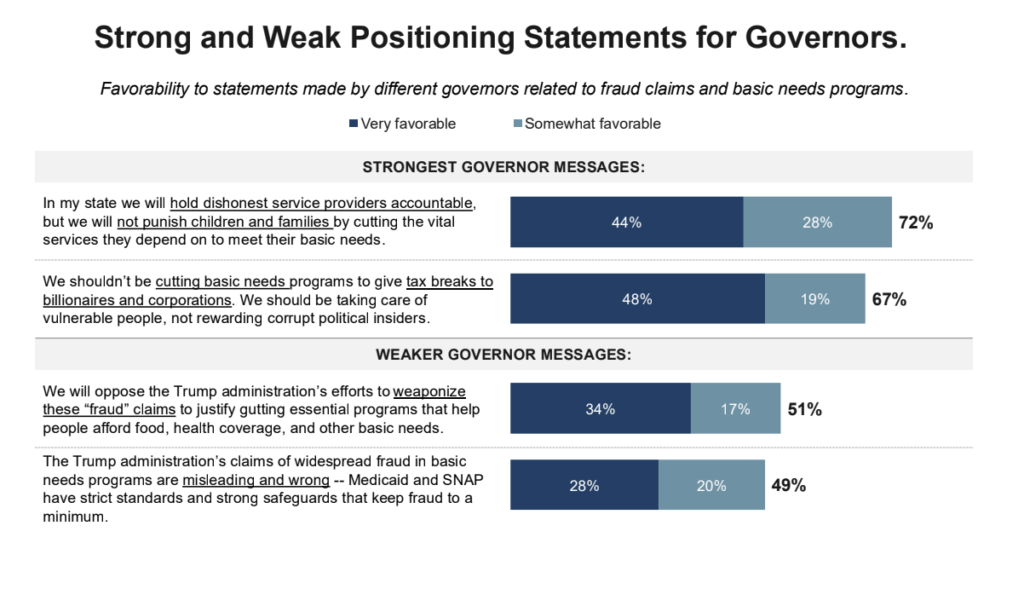
Similarly, we find that voters agree strongly with governors who focus on protecting their people from cuts to basic needs programs, and those who pledge to hold dishonest service providers accountable. However, those who discount or dismiss fraud concerns elicit much less agreement and much more opposition.
- Online survey of 1,503 U.S. voters matched to the voter file, conducted March 11-16, 2026. The survey’s credibility interval is ±2.53 percentage points for the full sample, with higher tolerances for subgroups. NOTE: Some percentage totals may shift a point due to rounding. ↩︎