What the Public Really Thinks About Fraud Claims and Basic Needs Programs
Some policymakers have made fraud claims central to its push to cut federal funding for basic needs programs. But what do voters actually think? Hart Research conducted a national survey of 1,503 registered voters in March 2026 for the Partnership for Basic Needs, and the findings are clear: support for Medicaid, SNAP, childcare, housing, and other programs remains strong and unmoved even after a year of exaggerated attacks by the Trump administration.
Voters take fraud seriously — but a large margin (49 percent vs. 38 percent) disapproves of Trump administration efforts to freeze or block basic needs program funds to states because of claims of fraud. By almost 2 to 1, voters are more concerned that such funding cuts will hurt vulnerable people than they are that fraud and abuse are being “tolerated” in these programs.
Key Takeaways
- Support is holding firm. Favorability for every basic needs program tested remains above 60% — and has ticked upward since 2025 despite sustained attacks on basic needs programs.
- Voters want more funding, not less. 52% want federal funding increased; just 16% want any cuts.
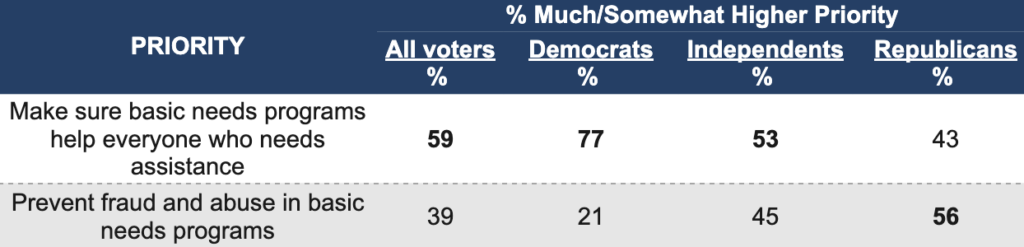
- Fraud concern is real but doesn’t justify cuts. Two-thirds of voters are concerned about fraud — yet 59% say ensuring programs help everyone who needs assistance is the higher priority, vs. 39% who prioritize fraud prevention.
- Framing matters. Governors who pledge to hold perpetrators of fraud accountable while focusing on the harm of program-wide cuts win the debate by 20 points. Those who dismiss fraud as “just an excuse,” see that advantage shrink to 6 points.
Finding 1: Support for Basic Needs Programs Is Holding Firm
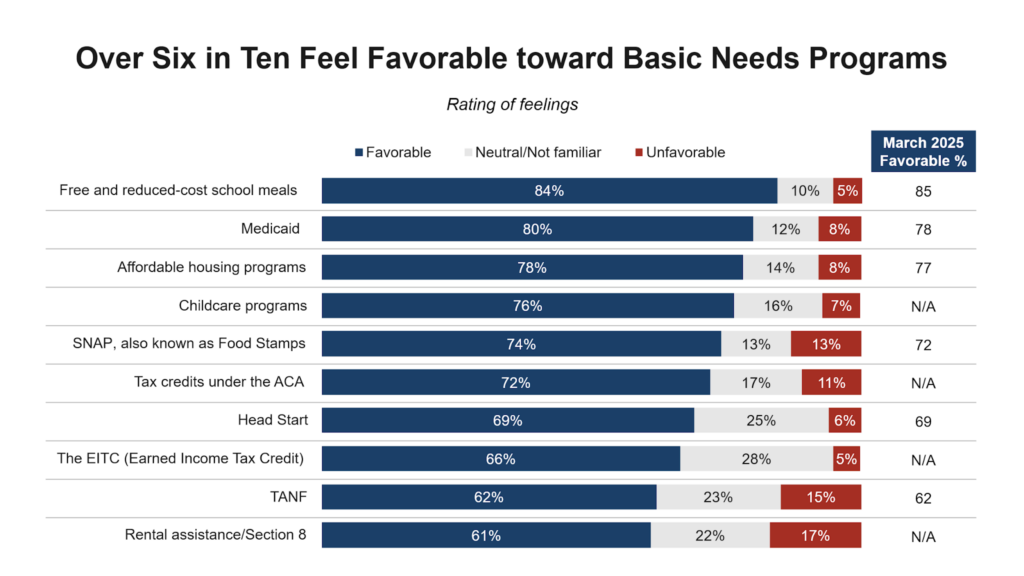
Despite targeted attacks from the administration, favorability for basic needs programs has not eroded — it has trended upward. Medicaid climbed from 78% to 80% favorability. SNAP rose from 72% to 74%. Free and reduced-cost school meals lead at 84% favorable. A full year of fraud-focused attacks has not impacted public confidence in these programs.
Key program favorability (March 2026):
- Free and reduced-cost school meals: 84% favorable
- Medicaid: 80% favorable (up from 78% in 2025)
- Affordable housing programs: 78% favorable
- Childcare programs: 76% favorable
- SNAP (Food Stamps): 74% favorable (up from 72% in 2025)
- Head Start: 69% favorable
Finding 2: Voters Want More Funding, Not Less
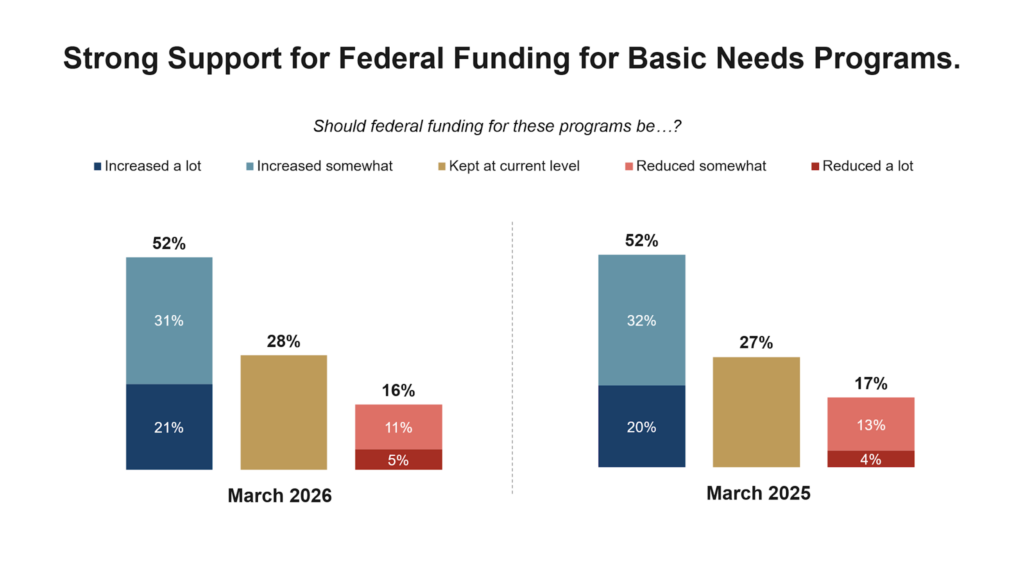
52% of voters want increased federal funding for basic needs programs, including 21% who want it increased a lot. Just 16% want any reduction. That margin (+36 points) is virtually identical to a year ago (+35), showing the administration’s fraud messaging has made no dent on the belief that basic needs programs should be supported through more funding.
Support for increased funding spans demographics: independents (55%), suburban voters (53%), Latino voters (63%), voters aged 18–34 (62%), non-college-educated voters (55%), and even 48% of low-income Republicans (household incomes under $50,000).
When asked to choose a phrase that best describes these programs, voters reject negative framing by 2-to-1: 64% say basic needs programs are “a good investment for the country,” while just 31% say they’re “full of fraud and a waste of money.” Similarly, 65% say these programs mainly help people who need support.
Finding 3: Fraud Concern Is Real — But It Doesn’t Justify Cuts
It’s true that voters are concerned about fraud: 67% consider provider fraud a very or fairly serious concern, and 66% are concerned about ineligible people receiving benefits. Although the public is not dismissing the issue, concern about fraud does not translate into support for cuts to basic needs programs.
A majority, 59%, say the higher priority should be ensuring programs help everyone who needs assistance — versus just 39% who say preventing fraud should be the top priority. That gap holds across every region and every age group. Even among independents, 53% prioritize helping people over fraud prevention. Across all voters, 73% say their biggest worry is that fraud claims will result in cutting support for people who genuinely need and deserve it.
Finding 4: How We Talk About This Matters Enormously
The survey included scenarios in which governors vow to hold those who commit fraud accountable while focusing on the harm of blocking funding for basic needs programs. Such scenarios beat the administration’s arguments about rampant fraud by 20 points (57% to 37%). But governors who dismissed fraud claims as “just an excuse” saw that advantage collapse to just 6 points (50% to 44%) — a 14-point swing based purely on framing.
The highest-rated governor statement (72% favorable): “In my state we will hold dishonest service providers accountable, but we will not punish children and families by cutting the vital services they depend on to meet their basic needs.” The weakest statements (44–49% favorable) were those that called fraud claims “misleading and wrong” without any commitment to accountability.
The Bottom Line
A large majority of Americans —across party, age, geography, and income — view basic needs programs favorably, want them funded at higher levels, and reject using fraud claims as justification for cuts. A full year of fraud-focused messaging from the administration has not moved the needle.
The data suggests a clear approach: accountability paired with protection. Acknowledge that fraud must be addressed. Then make clear who gets hurt when programs are gutted: not fraudsters, but children, seniors, parents, and working families who play by the rules and depend on these programs to meet their most basic needs.1
- Methodology: Online survey of 1,503 U.S. registered voters matched to the voter file, conducted March 11–16, 2026 by Hart Research Associates for the Partnership for Basic Needs. Credibility interval ±2.53 percentage points for the full sample, with higher tolerances for subgroups. ↩︎